Friday, October 11, 2013

Let's Make Quiche!

Quiche sounds like one of those fancy-pants kind of recipes, doesn't it?  I mean, just the name:  Quiche.  It sounds like it might be too much work.  It sounds like we might have to dress up for it.  Add the fact that it needs a crust, and it sends most gluten-free people running in the opposite direction.  But it doesn't have to be that way!  Quiche is actually a very simple dish to make, and the great thing about it is that you can use up many of the leftovers in your fridge when making it.  It transforms little odds and ends from the fridge into a new gastronomic experience.  Since we already know how to make a simple gluten-free crust (gluten-free pie crust), we've got this in the bag.


Just look at that beautiful quiche!  I snapped this photo right as I was about to take it out of the oven.  See how "poofy" it looks?  That will settle down a lit bit as it cools.

Start with a gluten-free pie crust as you see on the left.  (Here is my recipe for gluten-free pie crust.)  Then place your shredded cheese in the bottom of the pie pan and distribute it evenly.  I like to press down just a bit to flatten it some.

I had lots of onions and broccoli left from my garden, so I used them with some ham.  What you see here is about one small onion, 8 oz of ham, and a small broccoli head.  Fry it all in a couple of tablespoons of ghee (how to make ghee) or oil until lightly browned.  I sprinkled on a teaspoon of herbs de provence and some garlic powder while it was frying.

Now evenly distribute your fried vegetables and meat over the cheese.  Then beat the eggs in a small bowl and add the milk.  How much you use depends on how big your pie pan is (see below).

Pour the egg and milk mixture evenly over the food in the pie dish.  I usually pour it around and around in a circle.  Then sprinkle some paprika over everything.  It gives it such a nice color when it's done baking.

On the left you can see the quiche just as I was about to take it out of the oven.  On the right it has cooled about an hour.  Some of the "poofiness" has settled down, which is normal.

Always let your quiche rest at least an hour before cutting it or it will be total mush.  Here is a slice after just one hour, and doesn't it look delicious?!  I can attest that it was.  ;)


FORMULA:  The "formula" for quiche is simple:  1 egg for every 1/3 cup of milk.  This is what you need to make a good custard, which is really all a quiche is.  I use eggs from my own chickens, but I would recommend that you use extra-large eggs if you have to buy them.  If you're making a deep-dish quiche as I did above, you will need 4 eggs and 1 and 1/3 cups of milk.  If you're making a quiche in a regular-sized pie pan, 3 eggs and 1 cup of milk will be sufficient. 
1 gluten-free pie crust (recipe here)
3 or 4 eggs (see formula above)
1 cup to 1 and 1/3 cups of milk (see formula above)
shredded cheese:  I used cheddar.  You can use other cheeses.  Use 8 oz for a deep-dish pie pan and 6 oz for a regular-sized pie pan.
Any combination of meat and/or vegetables.  You only need a small amount.  I used a small head of broccoli, a small onion, and 8 oz of ham.
spices/seasonings:  I used 1 tsp of herbs de provence and a bit of garlic powder

Preheat your oven to 375 degrees.  Line your gluten-free pie crust with shredded cheese.  Saute your vegetables and meat in a little bit of ghee (how to make ghee) or oil until lightly browned.  Add spices and seasonings as desired.  Distribute the meat and vegetables evenly over the cheese.  Beat the eggs and then add the milk to them.  Pour this evenly over the meat and vegetables in the pie pan.  Sprinkle on some paprika.  Bake at 375 degrees for 1 hour for a deep-dish pie pan or 45 minutes for a regular-sized pie pan.

How do you know when a quiche is done?  Reach in the oven and jiggle it a little.  It's a custard, so it should all jiggle slightly in one piece if it's done.  If it's not done, you will see some liquid still moving around in the center as a quiche cooks from the outside first and then inward.  If in doubt, leave it a little longer.  It won't hurt it.  ALWAYS let your quiche rest at least an hour before cutting or you will ruin it.  The custard must settle.

TIPS:  
1.  You may have noticed that I don't use a special straight-sided quiche pan, which is roomier than a regular-sized pie pan.  I'm happy with my deep-dish pie pan, and I really couldn't see the need to buy yet another pan and find room to store it.
2.  If you are buying your cheese already shredded, be sure to read the label to make sure that wheat flour hasn't been added to keep the cheese free-flowing.  
3.  You don't need a large amount of meat and vegetables because after lining the crust with cheese, there really isn't that much more room.  You don't want your vegetables to stick above the custard too much or they might burn.  As you can see, my broccoli got a little singed just at the tips, which I actually like, lol.  
4.  You can use cheddar, jack, or Swiss cheese (Gruyere is very good).  
5.  Use your imagination for suggested fillings:  mushrooms, tomatoes, fresh herbs, marinated artichoke hearts, bacon, etc.  Add some gluten-free soy sauce if you like--that makes it really yummy.  Every quiche is a masterpiece, so don't be afraid to experiment!

Thursday, October 10, 2013

How to Build a Fire in a Wood Stove

I've been heating my house with wood for most of my adult life, so I never really think twice about starting a fire.  For me, it's like tying my shoes.  But it occurred to me that some people might not know how.  Perhaps you're thinking of getting a wood stove to heat your house someday?  It can be a little intimidating to start a fire for the first time, so this tutorial is for you.  I have a Jøtul stove and it's the largest one they make because I don't just use a stove for ambiance, I use it to heat my entire home.  This stove has two front doors that open and a side door on the right.  We'll be using the front and side doors for this tutorial, although some stoves only have one door.


Some people think that heating with wood pollutes the air, but I ask you to consider the alternatives.  Wood is a local product, and when grown in a respectful and sustainable manner, it is an indefinite product.  Getting your wood locally puts local people to work and improves your local economy.  If you cut your own, it's cheap or free if you own the land on which the wood is growing.  It doesn't have to be transported over large distances, so you don't have to worry about using fossil fuel, although you may use a tiny amount of fuel for the saw.  And you know what?  Nobody ever fought a war over getting wood to heat their home.  So let's get started!

You're looking through the front doors of my stove.  Clear the stove of ash.  You can see the grates on the left where I can just shovel the ash down into.  Every so often, I have to empty the box that catches the ashes.  Not all stoves have these grates.  If yours doesn't, you'll have to scoop the ashes out into a bucket.  It's okay if some old coals remain.  In the right picture, you can see that I have balled up several sheets of newspaper.  This will act as our tinder.

Start adding small, thin pieces of wood in a crisscross pattern over the newspaper.  Then add somewhat larger pieces on top of the smaller ones, keeping the crisscross pattern.  This is our kindling.

I've shut the front doors now and I've opened the side door on the right of the stove.  Light a match and hold it to a few places on the newspaper.  Then close the door but leave it open about an inch or so.  This acts as a bellows and forces air across the tinder and kindling and up the chimney.  What a big help!  If you've ever had to use a bellows in lighting a fire in a chimney (as I had to in the old days), you'll know just nice this is.  So leave this open for a bit and let it light the fire for you.

Now you can see on the left that the fire is starting to grow.  There's still some newspaper on the left bottom, but it will catch soon.  The picture on the right shows the fire starting to gain momentum.

Now that fire is looking pretty good to me, so I closed the side door.  Watch the fire for a bit.  If it stays lit well, then you're good to go.  If it starts to dwindle, it didn't catch enough and you have to open the door a bit longer until it catches better.  In the picture on the right, I was satisfied with my fire so I turned the damper down.  You can see a "plus" sign on the right and a "minus" sign on the left.  Going toward the minus sign more as I have allows less air into the stove.  This will keep the fire burning, but not too much.  It is only October and I don't need a rip-roaring blaze right now.  Come January though, I will.  The damper allows you to control the amount of air that enters the stove, and this allows you to control how fast the wood burns, which can be very helpful in keeping the heat down a bit or if you don't have a lot of wood.

The fire on the left is going well.  It's in its initial stage of fury and will die down some, which is what I want.  But this is a good fire.  As it burns on and on, a nice coal bed will develop, and this is what keeps you warm.  The coal bed heats the stove itself, which radiates out a lot of heat.  On the right you can see the top of my stove.  It's a good idea to get a stove with a nice flat surface like that.  Many is the day that I have lost power and have had to cook my breakfast, lunch, and dinner on this stove.  It can be a real lifesaver!


And that's all there is to it, really.  It's quite easy.  Wood heat is the warmest heat you will ever feel.  You will NEVER be warmer in your home than you will be with wood heat.  I do not suffer in the winter at all.  In fact, it's often quite balmy in my home, and I even walk around with a short-sleeved shirt sometimes!  Yes, there is ash to clean up, wood to haul, and sometimes dirty hands and splinters.  It can be a pain going out to the wood pile when it's snowing, but you just can't beat the comfort and security of wood heat.  I never have to worry about someone not delivering fuel to me.  I never have to worry about a wood shortage because I live in the most densely forested state in the nation--Maine.  Ah....it's going to be a good winter!

Tuesday, October 8, 2013

How to Make a Gluten-Free Pie Crust

When I tell people who are gluten-free or who are thinking of going gluten-free that they can still have their pie and eat it too, I get a couple of reactions.  Those who are already gluten-free give me the "hairy eyeball," with the "yeah right" look on their faces.  Either they don't believe me or they've attempted to make a gluten-free pie crust before or they've tasted another person's attempt at it, but whatever the reason, they think I'm living in a dream world.  Those who are thinking of going gluten-free just get tears in their eyes because they thought they had to give up pie.  (I prefer the latter reaction.)


Give up pie???  NEVER.  I will never give up pie, and you shouldn't either.  The fact is that you can easily have pie on a gluten-free diet--savory pies, sweet pies, whatever you like.  It does take a little more work and fuss, but you're probably already used to that anyhow.  The full recipe is below, but let's take it one step at time using pictures, which I think really help.

In your food processor, mix together the gluten-free flour, salt, and xanthan gum.  Then cut up a stick of cold butter and add it to that.  Pulse several times until the butter is in tiny pieces distributed throughout the flour mixture.

Add 1/3 cup of cold water and pulse several times until the dough starts to come together.  Then pulse until it forms one mass as you see on the left.  Remove the dough and shape into a ball quickly (the less pie dough is handled, the better).  It should feel slightly tacky but should not be gooey.  If it is, you need more flour.

Place a sheet of wax paper on your counter and sprinkle some gluten-free flour on it.  Place the ball of dough on it and flatten out a bit with your hand.  Then flour the dough as well.

Begin to roll the dough out with a rolling pin.  Look at that big crack on the bottom right of the first picture!  That doesn't happen as much with regular pie doughs, but it does happen with gluten-free pie doughs because we just don't quite have that wheat stretchiness.  That's okay.  Use your fingers to pinch the crack together and smooth it out.  You may have to do this several times.  It's okay. ;)

Continue to roll your dough out until it's big enough for your pan.  As you can see, I've gone over the paper at the top and the bottom.  I had flour there, though, so it won't stick too badly to the counter.  Just run a butter knife gently under the dough that has stuck to the counter.  Then place your hand underneath the wax paper and flip the dough over onto the pie pan, aiming your hand at the middle of the pan.

Gently remove the wax paper.  Oh dear!  Look what happened!  I have quite a crack there on the top left.  That's not a problem, though.  Gently begin to fit your dough down into the pan, lifting the sides and pushing downward, smoothing toward the edges of the pie pan.  Pinch any cracks closed and smooth them over.  Now you can see that the crack from the left picture is gone, but I have quite a few cracks that have sprung up along the edges of the dough overhanging the side of the pan.

That's okay, though.  Dip your fingers in a bit of water and begin to pinch those cracks together, "repairing" them.  You could stop here at this first picture, fill the pie, and put another crust on and bake it.  But let's go on further and make just one crust.  So, gently pick up the edges of the pie crust and fold them over so you have a double layer of crust all around the top.  Keep folding and pinching until you smooth it all out.  The height of the pie crust is a bit above the edge of the pan now, and I've pinched it all closed.

Now flute your edges to make the pie crust look pretty.  And there you have it!  Don't worry about the bumpiness you see along the inner sides.  You're going to fill and bake this pie, and no one will ever see it.


1.5 cups (195 g) of gluten-free flour
1 tsp xanthan gum
1/2 tsp salt
1/2 cup (4 oz or 1 stick) of cold butter
1/3 cup of cold water

In a food processor, mix together the gluten-free flour, xanthan gum, and salt.  Cut the butter in pieces and add it.  Pulse until the butter is in tiny pieces.  Add the cold water all at once and pulse on and off to mix in, gradually pulsing more until the dough comes together.  Touch the dough.  If it's watery and gooey, you need more flour.  If it's dry as a popcorn fart, you need more water.  Remove the dough and smooth out over floured wax paper.  Roll the dough out, pinching together any tears that may occur.  Flip the dough into a pie pan.  At this point you can fill the pie, roll out another crust, cover the pie, smooth it and flute the edges, cut steam holes, and bake according to your pie recipe.  OR, you can make just one crust.  To do so, flip the dough into the pie pan, repairing any tears inside and on the edges with moist fingers.  Fold the dough edges over to form one smooth, thick layer at the top.  Pinch and smooth until even.  Flute the edges.  You can now fill this and bake as for a pumpkin pie or quiche, etc., or you can bake the pie shell itself.  To do so, line the pie crust with tinfoil.  Fill the pie plate with beans or dry rice that you don't intend to ever use.  (This will hold the pie crust down while baking.  I keep a bag of the same beans in my cupboard that I use over and over.)  Bake the crust at 450 degrees for 12-15 minutes.

TIPS:  
1.  I can't stress enough that a digital scale is a gluten-free person's best friend.  That 195 g of flour listed above is important.  If you use that measure, this pie crust should come out well.  If not, you may have to play with the flour/water ratio to get things to work.  It can be done.
2.  As for gluten-free flours, I use my own blend of sorghum and rice flours mixed with corn, potato, and tapioca starches.  I call it "Mel's Magic Mix."  It works quite well, but you can use whatever gluten-free flour you have at hand.  There are many options on the market now or you can mix up your own.  I like a 3:1 mixture of flours to starches.  Flours can have more or less moisture in them depending on the time of year and weather.
3.  Always use cold butter and cold water straight from the fridge.  Pie crust misbehaves when it gets too warm.  Handle it as little as possible, but don't be afraid to touch it when you need to.
4.  If you are an experienced pie crust maker, you may notice there is a bit more water in this recipe.  I find that gluten-free flours tend to be very "thirsty."  They seem to absorb water much more than wheat flour.  If you find your own gluten-free flour not to be so, then use less water.  Frankly, I think the above crust could have used just a little more water because it had so many tears.  But it all worked out in the end.  ;)
5.  Relax.  If this is your first time making gluten-free pie crust, it can be a bit of a challenge.  It's okay.  It doesn't have to be perfect.  You will get better with each attempt.  Keep in mind that I have over 35 years of baking experience under my belt, so yes, it seems simple to me but I realize it can be frustrating.  If you can afford it, go ahead and make a few just for practice.  You can always use them one way or another, even if your first attempt doesn't work well and all you do is bake the scraps with cinnamon and sugar until they're crispy.  They'll still be delicious.

Monday, October 7, 2013

Wheat Prejudice


It occurs to me that even though I am gluten-free and happily embrace the gluten-free lifestyle, I have still looked at the world through wheat-prejudiced eyes.  Having grown up with a constant supply of wheat products, I have been tainted.  My eyes look for a certain color in baked goods.  My nose anticipates a certain wheaty-yeasty odor.  My mouth searches for the wheaty-sweet flavor.  My ears twitch at the sound of the sigh a wheat dough makes when being punched down.  My hands reach for the velvety and stretchy smoothness of wheat products.

I wasn’t even aware of this for the longest time.  All of my baking experience--all of my life!--was centered around wheat.  Because of this, I never even considered there were other possibilities for food preparation.  It’s not that I chose to avoid other possibilities.  I simply didn’t even know they existed.  What a small world I lived in.

Then I was forced into a strange new place without wheat and had to fend for myself.  But how to do this when I brought all of my subconscious wheat prejudices with me? 

It begins with the beginning.  Everyone who goes gluten-free begins at this point.  We search out other grains.  We turn our noses up to many of them because they don’t smell like they’re “supposed” to.  Our eyes are assaulted with bizarre colors.  Our hands feel strange and sometimes gritty or lumpy textures.  Our ears search in vain for the sizzle or sigh of what they have known.  Our mouths turn down sadly seeking that sweet (and addictive!) flavor they cannot find.

That’s how it starts.  We find other things and get disappointed.  Then we get over it and move on to the next phase.

“We will make these flours behave the way we want them to!”  We force them to do our will.  We add xanthan gum or guar gum or chia slurries to make them stretchy.  We often add unnecessary yeast to make them mimic a reminiscent flavor.  We grind them and beat them mercilessly to make them more pleasing to the eyes and hands.  “You will be wheat,” we say, “and you will like it!!”

And off we go, baking until our hearts are content.  We start humbly and then get more skillful and daring.  We grab our old wheat recipes and say, “Yes!  We can still do this!”  Sure enough, as time goes by, we produce some pretty wonderful things.  Not quite what we remembered, but still delicious.  We proclaim ourselves the victors.  And in a way we are the victors.  We have taken a sad state of affairs--not being able to eat what the entire nation eats and what our society is built upon--and made it into something that rivals (and occasionally surpasses) the grain we cannot have.  We proclaim to the world, “I am normal (again).”

That’s the second step.  It’s a good step because it builds confidence and releases anxiety, but it’s only a step.  Many people stop here.  And why not?  If you’re happy with what you can make or buy, if it pleases you and excites your senses, why shouldn’t you stop right here?  The answer is that it is perfectly fine and wonderful to stop right here.

Unless you’re haunted, like me.  The day I realized that I had brought my wheat prejudices with me into every culinary attempt I made was a real eye opener.  I realized that while I had been so busy forcing and beating the other grains, I couldn’t hear what they had to tell me over the din of my own wheat-crazed fury.  Sadly, I didn’t even know they were talking to me.  Now that’s prejudice.

But what if we lived in a world where wheat had never entered?  What if we lived in a world without wheat prejudice, a world where we explored each new grain or bean completely, coaxing out its own unique qualities?  What would this feel like?  What sort of culinary feats could we attempt by discovering what other grains had to offer without expecting them to behave in a manner inconsistent with their nature?

The answer is all around us, hidden as usual in plain sight.  There are so many societies that have already lived like this, developing their own unique gastronomic experiences.  But they are fading--fading because they, too, have been inundated and hypnotized by cheap and addictive wheat imports and a dominant wheat culture that tells them what is best for them (and isn’t).

Our job then is to resurrect what has been lost and preserve what is still practiced by these societies.  Look to India for their dosas and idlis made with fermented rice and urad dal batter and also their papads.  Look to Ethiopia for their sponge-like injera.  Look to China for their cellophane noodles made from bean starch.  And so on and so on.  There are so many wondrous foods made from as many wondrous grains and beans, just waiting to be rediscovered.  However, we must rediscover these delicacies without the prejudiced “wheat eye” being cast upon them.

We must take in the new aromas and textures of these other products.  We must slide them along our tongues like we would any new food offered to us without expectation, just an inquisitive nature.  We must watch and hear how they react to different cooking and baking processes as we would with eyes and ears seeing a new Broadway play for the first time.  What wonderful memories will be bestowed upon us?  What will become our new cherished traditions?  This and much more lies before us as we head out on our unexpected journey, finally unburdened by the heavy mantle of wheat.

How to Dry Tomatoes

When the tomatoes starting coming in on my little homestead, putting them by one way or another begins.  First comes the salsa.  By popular request (and threats), that must be made first.  So I always make a minimum of 35 pints of tomato salsa (peach salsa is separate).  Once that has been done and more tomatoes ripen, I can the tomatoes themselves.  San Marzano tomatoes are the best for sauce, salsa, canning, and drying.  So I then can several quarts of whole tomatoes and crushed tomatoes.

Then time goes by and we get into Fall.  The salsa is all done.  The tomatoes are all canned.  But we still have more tomatoes.  This is the time of year when I begin to dry tomatoes, and San Marzanos are the best for this!  Any "plum" sauce tomato will do, of course, but San Marzanos have the most flavor and are extremely prolific.  So let's get started!

Wash all your tomatoes and set aside to dry.  Then cut them in half lengthwise as you see the tomatoes on the left.  Put a screen sieve in the sink and, using your thumb, scoop the core and seeds out into the sieve.  The tomatoes on the right have all been scooped.

Now, grab a tomato half and begin to turn it inside out, but stop when it becomes flattened.  It's okay if the sides split a little like you see in the picture.  Pack your dehydrator trays with the tomatoes, cut side up.  Dry at 135 degrees for 8 to 15 hours or so.  Some tomatoes will finish drying before others.  That's perfectly fine.

Here you see the finished product.  I wish this picture was better because it does not do these tomatoes justice.  The tomatoes are dry when you can't feel any more "squishiness" to them.  Slight pliability is fine--squish is not.  Remove the tomatoes that are dry, and continue to dry those that need more time.


And really, that's all there is to it!  It's so simple you might not even think of it, but it's a wonderful way to preserve the bounty of your gardens.  You get to a point where you get "all canned out,"  lol.  Drying is the answer at that point.  After I dry the tomatoes I vacuum pack them in small portions in plastic bags.  This is a real plus because it makes the tomatoes last a really long time--years, as opposed to maybe one year without vacuum packing.

What do you do with these dried tomatoes that look like shoe leather?  Ah, those succulent beauties!!  You can drop them right into soups and stews and they'll plump up all on their own.  You can rehydrate them in water, drain, and use in salads.  I like to put pepperoni, feta cheese, olives, basil, rehydrated tomatoes, and a good amount of olive oil in a bowl.  Maybe add a few pickled hot peppers.  Mix and eat--it's great with a glass of wine!  You can also use rehydrated tomatoes in mayonnaise-based dips or as a thickening base along with onion in Indian food.  The sky is the limit as they are so delicious!  Once you have a bunch of them, you'll find hundreds of uses for them online, and you'll wonder how you ever lived without them!

NOTE:  If you don't have a dehydrator, you can dry your tomatoes in the oven.  Set your oven for 200 degrees, or lower if you can.  Put the tomatoes on cake racks and dry them the same way as above, removing those that are dry and leaving those that need more time.  AND, if you live in a very hot climate, you can dry your tomatoes in the sun.  Place them on a screen and cover with another raised screen to keep the bugs out.  Dry the same as above.  This only works in a hot climate when the sun is shining, but it works quite well if you happen to live in an area like that.

Sunday, October 6, 2013

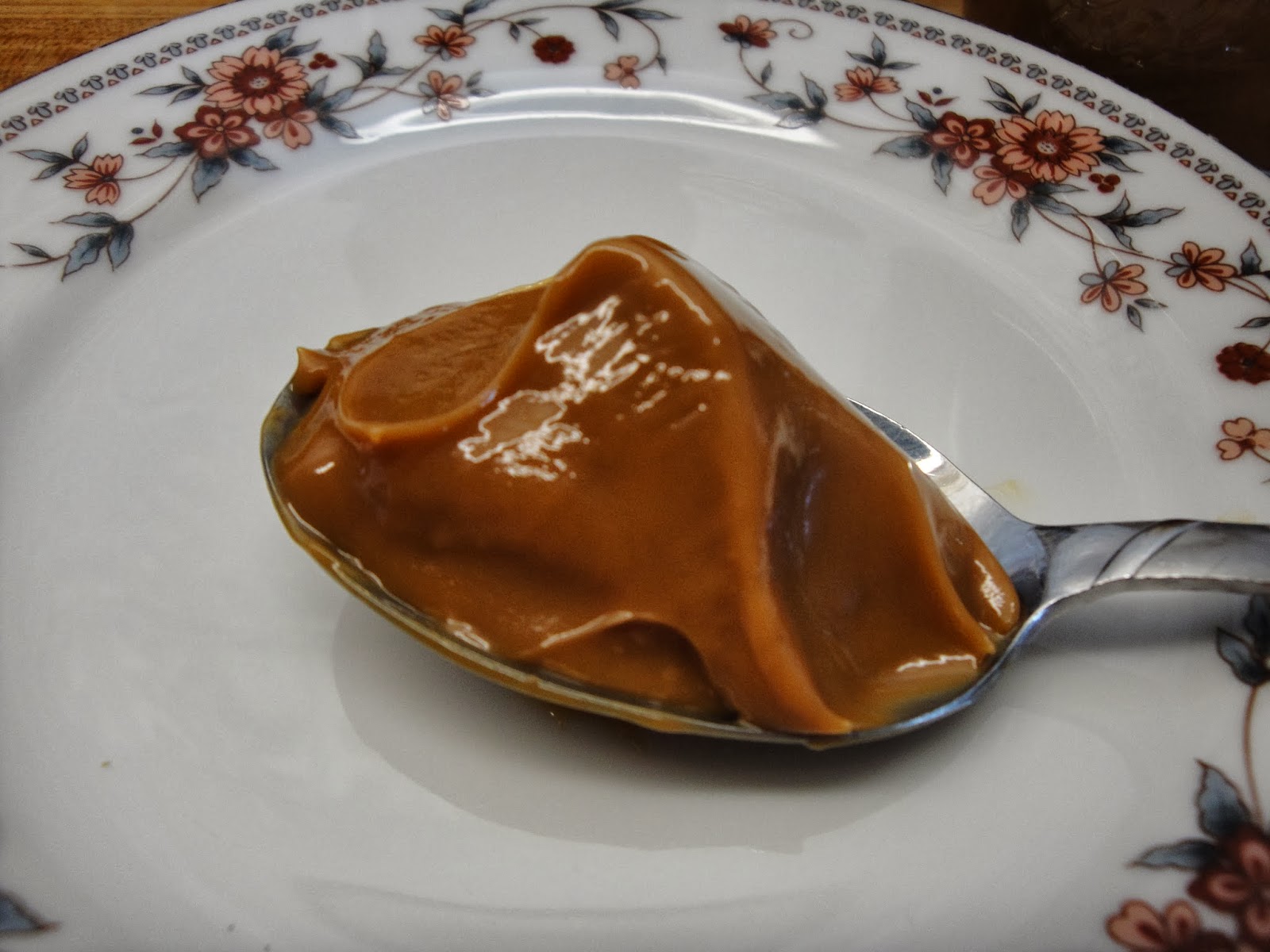
How to Make Dulce de Leche (Milk Caramel)

If you have never had Dulce de Leche (literally "milk candy"), then you have missed out on one of the simple yet great pleasures of life.  Surely there can be nothing sweeter, more pleasant, more deliciously divine than Dulche de Leche--and it's gluten-free, of course!  When I was young, we used to take cans of sweetened condensed milk and place them unopened in a pot of boiling water and boil them for a couple of hours.  Usually they came out good--but not always because we couldn't tell what was going on in the unopened can.  I've heard they can explode if you forget about them on the stove (dangerous!!).  Experience proves invaluable here, but now there's an easier way.

Just look at that!  The best Dulce de Leche--milk caramel--you will ever eat!

And what will you do with this Dulce de Leche once you have it, you ask?  That depends on how thick you decide to make it (see recipe below).  If you make it thinner, you can pour it on ice cream or other desserts.  If it's of medium thickness, you can spread it on gluten-free muffins or bread.  If it's thick, you can use it as a filling in gluten-free cupcakes or in other desserts that call for a thick filling.  Oh, who am I kidding?  You can just eat it out of the jar, too.  That's what I often do, lol!  It's like a wonderful, thick pudding.
 
What we're going to do is use a crock pot to heat the sweetened condensed milk in glass jars.  This makes it safer to make and easier to see what's going on.  Also, the final product is already saved in a jar.  You can't beat that for simplicity, so let's get started.

Here you see four 14-oz cans of store-brand sweetened condensed milk.  Pour the milk in clean mason jars.  Place a clean lid on and then a screw band.  I paid $1.99 per can and ended up with six half-pint jars, making each jar cost about $1.33--cheap for such a good final product!

Here the jars are nestled in the crock pot.  Then add hot water to cover the lids, cover the pot, and turn it on low.  In the second picture you can see the jars "cooking."

I wanted thick Dulce de Leche, so I left them in the crock pot for 9.5 hours.  Here they are already cooled down.  Of course, I couldn't resist opening one and testing it.  I had to make sure it wasn't poisoned before I gave it to my family, but somehow the contents of the jar disappeared, lol!  :)


4 14-oz jars of sweetened condensed milk
6 half-pint mason jars with lids and screw bands

Pour the contents of the sweetened condensed milk into the clean mason jars.  You'll need a silicone spatula to help you scrape it out of the cans.  What I did was pour each can into a separate clean jar, leaving about 3/4" of space at the top.  Those four jars were clean without drips so I set them aside.  Then I took what was left in each of the four cans and used the spatula to scrape it into the last two jars.  Yes--this can be sticky and messy, but the results are worth it.  Clean the two messy jars of drips using clean, wet paper towels.  Now place the lids on the jars, and then screw down the bands finger-tight (that is, don't use a vice grip).  Put the jars in a crock pot and pour hot tap water in just until it reaches above the jars.  Turn the crock pot on low.  Cook anywhere from 5 to 10 hours depending upon how thick and dark you want your Dulce de Leche.  The above picture shows jars that were cooked for 9.5 hours.  Remove the jars with a jar lifter (canning supplies) and set on a clean cloth to cool overnight.  Don't mess with the jars until they're completely cooled.

TIPS:  The bigger your crock pot, the more jars you can fit in.  Different jar manufacturers make differently shaped half-pint jars.  Some are fat and squat and some are taller and thinner.  You want to make sure that you can at least get the water up to just above the lids and still have about 1 inch of headroom in the crock pot.  I just made it in having enough room in mine!  Experiment with how you want your Dulce de Leche--thinner or thicker.  Remove two jars at five hours, two at seven hours, and two at nine or ten hours.  Then try them when they're cool and decide which you like best, depending on what you need it for.  If you want a pourable product, you may want to stop the cooking at five hours.  Experiment and have fun--no matter what you do, it will be delicious.  Dulce de Leche can be stored in the fridge for at least a couple of weeks.
 
NOTE:  I used clean, sterilized jars and lids and they did "ping" upon cooling, sealing in the contents with a vacuum seal.  You may use that knowledge at your own discretion.

Thursday, October 3, 2013

Cinnamon-Sugar Almonds!


Ahhhh……cinnamon-sugar almonds.  Soooo delicious!  You know how you walk through a mall or a large department store and they sell these wonderful almonds?  And the scent is everywhere?  And people are walking around snacking on them, looking like they’re in heaven?  And you want to buy them, don't you?  But you’re afraid because they might have hidden gluten in them?  Should you take the chance?  Should you??  After all, they smell so good . . .

Well, now you don’t have to worry.  You can have your cinnamon-sugar almonds and eat them too, and they just might be even more delicious than those sold in stores, and they’ll certainly be cheaper!  Oh, and of course, they’ll be gluten-free.  Full recipe is below, but let's start with some nice pictures.


In a small bowl, combine the sugar and cinnamon with a whisk.  Mix thoroughly.  In a large bowl, beat the egg white until it just starts to get frothy--about 1 minute with a hand mixer.  Then add the salt and vanilla and mix again for half a minute.


Add the almonds to the egg-white mixture and stir well to coat.  Then add the cinnamon-sugar to the almonds and mix well.  You want to make sure that all the almonds are coated with the sugar mixture.
 

Spread in a single layer in a well-greased roasting pan.  I'm using an  18 x 12 pan here, and yes it's nonstick, and YES you must still grease it!  Bake for half an hour at 300 degrees, carefully turning with a spatula and gently spreading out again after 15 minutes.  The picture on the right shows the almonds just after coming out of the oven.  Mmmmm......
 

And just to tempt you a little more.  :)  OMG!  They're so good!


1 pound whole raw almonds
1 1/2 cups (10.5 oz) sugar
2 tablespoons cinnamon
1 egg white
2 teaspoons vanilla
1/8 teaspoon salt

Preheat your oven to 300 degrees.  Grease a large baking pan.  Combine the sugar and cinnamon in a small bowl.  In a large bowl, beat the egg white until frothy--about 1 minute with a hand mixer.  Add vanilla and salt to the egg white and beat again for half a minute.  Add the almonds to the egg-white mixture and stir well to coat completely.  Add the sugar-cinnamon to the almonds and mix well.  Make sure the almonds are completely coated.  Spread out in a greased pan.  Bake 30 minutes at 300 degrees, turning the almonds over gently with a spatula after 15 minutes and spreading out again in the pan.


These almonds are one of my best sellers.  Many people do not have the time for baking or the knack for it, but they want to have delicious snacks they can trust.  That’s where I come in.  When you bake your own, you know what goes into it.  My customers trust me, and your family can trust you to make them wonderful, delicious, gluten-free snacks!

TIP:  You MUST grease the baking pan even if it's nonstick.  These things will stick like crazy if you don't!